Fine-Tuning vs Prompting vs RAG: A Decision Framework for When to Fine-Tune Your LLM
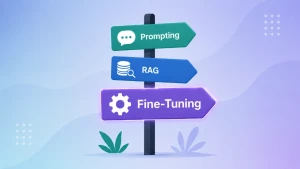
 The article compares prompting, RAG, and fine-tuning, advising to try prompting first, then RAG, and fine-tune only when needed.
Summary
Prompting is the fastest and cheapest way to guide model behavior through instructions, effective for tone, format, and simple behavior changes. Retrieval‑Augmented Generation (RAG) lets the model fetch up‑to‑date information from external sources, ideal for dynamic company knowledge but requires retrieval infrastructure. Fine‑tuning modifies the model weights with task‑specific data to instill consistent behavior, style, or domain expertise, but it is slow, costly, and needs high‑quality training data. The article recommends a decision framework: start with prompt engineering; if that fails, try RAG; only resort to fine‑tuning when prompting and RAG cannot solve the problem, especially for consistent behavioral issues, stable knowledge, and high‑volume use cases. A readiness checklist is provided: have prompts been exhausted? Is the problem behavioral rather than knowledge‑based? Is the information stable? Are there at least 500 quality examples? Is the task frequent enough to justify the investment? Real‑world examples illustrate the choices: RAG for frequently changing documentation, fine‑tuning for legal or medical assistants needing consistent style, and combining all three methods can yield the best results. Costs and effort are outlined, noting that while compute costs have dropped, data preparation and validation remain the main challenges.
(Source:Techgenyz)